Thursday, February 12, 2015

No Money? Credit Shot? Who Cares....Your Swipe File Is Here!


I just got an email from one of my prospective clients. This is what she wanted to know:

"I soooo desperately need some money and a new car, but I don't have a single penny to my name to work "from".

How can you help a person who financially has NOTHING? And, my credit is SHOT, as a matter of fact, CAN YOU HONESTLY HELP ME???"

This is a common question we get, so I am glad she asked.  If you THINK there is no way to invest in repairing your credit without paying thousands of dollars, then I am personally telling you that YOU ARE WRONG!

But before I became a credit repair consultant, I thought the same thing...how in the word can anyone do this, it MUST be bogus! But what I have learned is that you don't know, what you don't know! And it wasn't until I started EDUCATING myself that I found out that there were indeed ways to repair my credit that does not require paying thousands of dollars or enrolling into a monthly credit repair program which takes years to complete.

If you don't know how, then say you do not know.  But DO NOT, dismiss this without looking into it first.  And for heaven's sake...DO NOT listen to all the negative people in your life telling you that it is not possible.  Please note that this is the same exact technique I used to take my credit score from 535 to 811 in only 90 days.

So, the people telling you that it isn't possible are obviously not credit repair experts, so why would you even listen to them?  You don't let a lawyer perform heart surgery on you, do you? Of course not!

So take a look at The Ultimate Credit Repair Swipe File and see for yourself how you can start repairing your credit today.  It costs NOTHING to find out the truth, that these powerful proven letters are the key to your success.  You owe yourself that much.  After-all, without doing something new or different, your circumstances are destined to stay the same!


       ERADICATE THOSE NEGATIVE ITEMS FROM YOUR CREDIT REPORT NOW HERE

P.S. You have nothing to lose because it's absolutely FREE, but you have everything to gain.  Start by taking action now.

P.P.S. Please feel free to contact us at 877-292-0656 for a free consultation should you need further assistance of have any questions.

Cheers To Financial Freedom,

Stephanie "The Credit Repair Queen"
Certified Credit Consultant 


Saturday, January 17, 2015

Poor Credit??? You Should Understand Your Credit Rights

Your Credit Rights... The Fair Debt Collection Practices Act
Many consumers have their legal rights violated by collectors without even knowing it. The Fair Debt Collection Practices Act is designed to stop harassing, unfair, and abusive debt collection practices.
Knowing the important details of this act will help you stand up against abusive collection practices and stop collection companies from violating your rights.
There are many requirements debt collectors must abide by per the FDCPA.

Debt collectors are not allowed to tell others details about the consumer including that they owe a debt, they cannot communicate with anyone other than the consumer more than once, not communicate through post card or have ANY markings on the outside of their envelope indicating they might be a debt collector.
Basically, collection companies cannot use the fact that they are a debt collector to bully you into paying.
They cannot identify themselves as a debt collector to your employer, and they cannot send things in the mail to identity they are a debt collector with the intent of embarrassing or causing other hardship to you.
Debt collectors are also not allowed to call a consumer at an unusual time or place. This includes before 8 a.m. and after 9 p.m. A debt collector cannot contact a consumer at their place of employment if they have reason to believe this is prohibited by the employer.
They are also required to immediately cease and desist contact with you if you are represented by and attorney, or if you notify them to do so in writing or notify them that you refuse to pay the debt.
There are many restrictions of abusive and harassing practices in the FDCPA also. Debt collectors are prohibited from using the threat of violence or other criminal means to cause harm to the consumer.
The use of obscene language is prohibited along with the publication of information that the consumer allegedly owes the debt.
Debt collectors cannot cause a consumer’s phone to ring repetitively with the intent to annoy or harass any person. And they have to clearly identify themselves on every phone call.
False and misleading representations are also prohibited per the FDCPA. These include the debt collector identifying themselves as an affiliate of the United States government, miss-representing the legal status of a debt, or that they are an attorney if they are not.
Your debt collectors cannot falsely represent that the nonpayment could result in the arrest or imprisonment of the consumer or the seizure of their property or garnishment of their wages unless such action is lawful and the debt collector intends on taking that action.
Debt collectors are not allowed to communicate to any person credit information which is known to be untrue or in dispute. They also cannot falsely issue you documentation representing itself as coming from the courts.
They also are prohibited from using any false representation or deceptive means to collect a debt. They must identify themselves to the consumer as a debt collector and that the nature of the call is for that purpose.
Debt collectors are NOT directly affiliated with the credit reporting agencies, and they cannot claim that they are per the FDCPA.
They cannot accept post-dated checks of more than 5 days, or attempt to collect more than what is owed due to the original contract.
They must also send a statement to each consumer within 5 days of contacting the consumer. This letter must contain many things including the amount of the debt, creditor’s name, and many disclosures specific to FTC language.
Any violations within this act can be costly to the debt collector, especially in the civil and class action aspects.


About the Author
Stephanie Lawrence is currently the CEO of Precision Credit Restoration.
At Precision Credit Restoration, she specializes in helping individuals improve their business credit scores and then leverage those scores to access the dream financial goals.
Stephanie Lawrence is also the mastermind behind the book: The Credit Repair Blueprint: The Secrets Behind Your Credit Scores And How To Beat The Credit Bureaus At Their Own Game. Her mission is to guide you from financial distress to financial success one household at a time.

For more information on credit scoring or business credit, visit www.precisioncreditrestoration.com.

Monday, December 29, 2014

Credit Scores and Inquiries

Inquiries Effect on Credit Scoring
 
Many people have heard before that inquiries lower the score.  As a result many customers will ask you whether this is true or just a myth.  Inquiries definitely impact the consumer credit score.


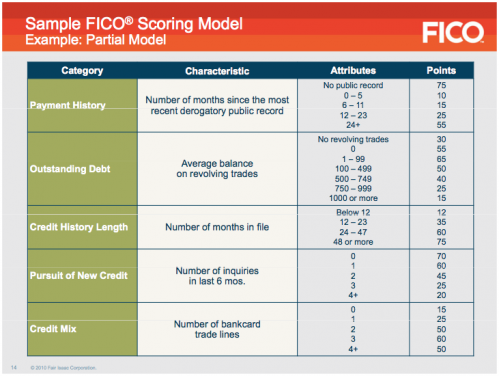
FICO score inquiries account for 10% of the total credit score.  FICO counts this to the part of their score that deals with the accumulation of new debt.


If consumers apply for a lot of credit within a short period of time, their scores will go down.  There is no set amount of drop per inquiry - it's bundles of inquiries in a short period of time that really impact the score, not just one single inquiry.


This means that when a customer applies for something and an inquiry is put on their report, their score might not go down at all.  But if they start applying for a lot of new credit in a short period of time, these groupings of inquiries will have an impact on their score.


However, there are exceptions: mortgage or auto loans.  If they go to apply for a mortgage, all mortgage inquiries within a 2 week time period only count as 1 inquiry on their credit report. The same applies for auto loan inquiries.


The reason for this, is that the score providers understand that consumers will commonly shop around for the best terms on home and auto loans, and they shouldn’t be punished for doing this. Plus, in the auto business, it is common for the consumer’s application to be sent to many different banks, which could also lower their scores, if FICO didn’t operate this way.


Accumulation of new credit or new inquiries on the report, accounts for 10% of the total credit score,  Insure your clients know about this, so they can minimize the amount of inquiries they put on their report further maximizing their scores.


For more details about your credit score and to learn ways to improve your credit status, please contact a representative at Precision Credit Restoration at 877-292-0656.  We are here to guide you from financial distress to financial success.  


Friday, December 19, 2014

What Should Potential Home Buyers and Those Refinancing Know About Credit Scores

When a third party pulls a copy of an individual’s credit profile and scores a “hard inquiry” occurs.  This credit review can have a negative consequence to your scores.  Do not have your credit pulled by any third party unless there is a very good reason for it like a pre-approval letter.  There are windows of time that a series of “hard inquiries” for the purpose of a mortgage will hurt your scores less (usually within 45 days) but what is essential to remember is more than 5 third party inquiries for any purpose can drop scores dramatically depending on the individual’s full credit profile. “Hard inquiries” impact credit scores for one year and stay on credit reports for two.

When you pull your own credit online it will not impact your credit scores. However, the scores that are available online to purchase are usually not the same as the scores used by mortgage lenders.

Most mortgage lenders use the “middle score” as the risk factor. When a report is pulled by a lender it includes merged information from the three credit bureaus Experian, Trans Union, and Equifax. Each bureau has a FICO score that represents the risk of the borrower. The bank takes the middle number not the average.


The score model used by most mortgage lenders has customized versions for each bureau therefore each bureau has created their own name for the version they use. They are:  FICO 4 (used by Trans Union), Beacon 5.0 (used by Equifax), and Fair Isaac Risk Model V2 (used by Experian). We refer to these as FICO 4 for an abbreviation.  All of these scores are very similar but they have small variations.  Lenders tend to follow the score models used by Fannie Mae and Freddie Mac. These scores are currently FICO 4 models and will not be changing any time soon.

The scores sold at the consumer site www.myfico.com are FICO 8 score models and will be changing to FICO 9 sometime this fall.  This will cause confusion and larger score differences between the consumer FICO scores and the mortgage banking FICO scores. 

If your team would like more info on the details of the differences between the FICO 4 model lenders use and the FICO 8/9 model sold to consumers, plus how to handle questions and concerns of loan applicants, referral sources, and potential home buyers please reach out to us and we will set up a meeting to educate and discuss (stephanie@precisioncreditrestoration.com).

Besides the differences in FICO score models there are also many scores sold online that are not FICO scores at all.

Some of these scores are:

●National Equivalency Score: sold by Experian and it ranges from 360-840 points.
●​Vantage 2.0 Score: created by all three credit bureaus and it ranges from a 501- 990 score with letter grades A-F.
●​Vantage 3.0 Score: a newer version which ranges from a 300-850 like the consumer FICO score. Although it is the same range as most FICO scores it is not the same.
●​Plus score: sold by the bureaus, it ranges from a 330-830 score and is strictly educational.
●​Equifax score: sold and created by Equifax and it ranges from a 280-850 score. It is sold for educational purposes.
●​Trans Union scores: they range from 300-850 points and are also sold for educational purposes.

The best way to find out what the FICO score used by a banker is would be to have a banker pull credit for pre-approval. 
​​
​Feel free to reach out to us at 877-292-0656 if you have any credit questions or reports you would like reviewed!

"Guiding you from financial distress to financial success"

Friday, December 5, 2014

How to prepare our future for financial success?

How should we be preparing our future Millennial clients for successful real estate purchases and financing approvals?


https://s3.amazonaws.com/roblyimages/accounts/1697/original/1397768065167-238mh9u4ygb9-90c334f2df6193c2cf7a72b966389989.png


Millennials (those under the age of 34) make up many of our current and potential home buyers/financing applicants.  With this in mind it is of great value for us all to learn more about their attitudes about homeownership and future investments and how we can help prepare them for success.


Here are some trends among Millennials:

-The National Association of Realtors Trend Study of 2014 found “8 out of 10 recent buyers considered their home purchase a good financial investment, ranging from 87 percent for buyers age 33 and younger, to 74 percent for buyers 68 and older.”

-Lawrence Yun, the Chief Economist and Senior Vice President of Research at the National Association of Realtors, said the Millennial generation, which is under the age of 34, is now entering the peak period in which people typically buy a first home. “Given that Millennials are the largest generation in history after the baby boomers, it means there is a potential for strong underlying demand. Moreover, their aspiration and the long-term investment aspect to owning a home remain solid among young people,” he said.  “However, the challenges of tight credit, limited inventory, eroding affordability and high debt loads have limited the capacity of young people to own.”

-Although Millennials have a much greater talent for navigating technology and social media, they are far from educated about credit and scoring.  The Fourth Annual Credit Score Knowledge Survey done by the Consumer Federation of America found that this generation falls short in credit knowledge.  About half of Millennials surveyed never pulled a copy of their free annual credit reports whereas with older adults, about 80% use free annual reports to view and learn about their credit.   When individuals are unaware of what is on their credit profile it is less likely they will have a curiosity about how credit works.  Many Millennials do not even know what kind of information is posted on credit profiles or how scores are tabulated.

How can we help these individuals & gain referrals?

We can send information relating to Millennials to our referral sources as well as our current, potential, and past clients.  This information will be really valuable to Millennials and also help us gain them as loyal customers in the future.

For referral sources, they will appreciate good quality info that they can use to enhance their reputation and gain referrals and trust.  In addition, our current customer base will appreciate our interest in helping those they care for, which will give us an opportunity to expand our business and build a great reputation.

Here are tips on credit and scoring to share with Millennials:

-Order your free Experian, Trans Union, & Equifax credit reports once a year at www.annualcreditreport.com and learn about what is on your credit reports.

-If you purchase the scores offered on the annual site understand they differ from FICO scores.  FICO scores are the scores used by most lenders to evaluate a borrower’s ability to pay back loans.

-FICO scores can be purchased at www.myfico.com.

-Paying a credit card, car loan/lease, student loan, store card, mortgage, or overdraft protection late can drop credit scores hundreds of points no matter how small the amount owed is.

-Starting to build credit at a young age can add many points to your scores as the credit ages.

-FICO scores over a 680 could save many mortgage applicants $100,000 or more over the life of a mortgage loan depending on the size and type of mortgage.  A 740 FICO score and above is considered excellent credit.

-Credit scores take time to build and improve so starting early is extremely important.

-Co-signing or signing for a friend or loved one’s cell phone, credit card, lease or loan can extremely damage credit scores for years to come and alter your ability to get loan approvals. If you have no control over paying the bill or are not comfortable paying the debt if it defaults do not sign up for it. 

-Being added on as an authorized user to a parent or trusted friends old credit card with an excellent payment history can add points to scores since it increases the average age of credit.  Beware of being added on to maxed out cards.
​
Feel free to reach out to us at 877-292-0656 f you have any credit questions or reports you would like reviewed!

Wednesday, November 19, 2014

The Truth About Credit Scores

Few credit related topics confound, confuse, and befuddle consumers like the subject of credit scores.
Popular television commercials, misinformed advice columnists and pretend credit experts are notorious for suggesting that consumers have only one credit score. Nothing could be further from the truth. The reality is consumers don’t have just one credit score but hundreds of different credit scores.


Equifax, Trans Union, and Experian are the three major credit bureaus that are responsible for maintaining data on more than 600 millions U.S. consumers about their credit management habits. The credit bureaus compile this data into credit reports and sell the information to lenders, insurance companies and even to consumers.

Credit scoring models are used to interpret and analyze the data on the credit reports housed by the credit bureaus. VantageScore and FICO are the two companies that produce credit scoring software used to calculate the most common credit scores. The credit scoring models designed by these two companies are similar, but they are certainly not identical and will certainly generate different credit scores for any given consumer.
At least 70 credit scores

To add to the confusion, there are different software versions for every credit scoring model that is commercially available. Under the FICO brand/umbrella there are about to be somewhere around 65 different scores available for purchase and use by lenders.  Under the VantageScore brand there are nine.

Counting just the credit bureau based credit scoring systems there are well over 70 different scoring models, which means you’ve got at least 70 different scores.

In addition to the credit bureau based scores like FICO and VantageScore there are countless other credit scores being used by lenders and insurance companies. Most of these companies will use custom developed scoring models that consider both credit report and non-credit report data, like information from an application.

These “custom application scores” are actually much more common than FICO and VantageScore credit scores. Most large lenders have several of these models in use at any given time.
Consumers almost always neglect the large number of non-risk scores that are being sold by the credit bureaus to lenders.

These marketing scores often measure the likelihood that you’ll respond to a credit card offer, leave for a competing lender, and generate a positive revenue flow. While these scores are not as commonly used as risk scores, they are still fairly common.Keeping track of the hundreds of credit scoring possibilities would be exhausting and is nearly impossible. Most of these scores aren’t even available for consumers to obtain under any circumstance.

Keeping track of so many scores
Keeping track of the hundreds of credit scoring possibilities would be exhausting and is nearly impossible. Most of these scores aren’t even available for consumers to obtain under any circumstance.

Having said that, there is still an effective way for consumers to control their credit scores. Credit scores are based on the data contained in a consumer’s credit reports, nothing more and nothing less. By controlling the information contained on your credit reports you can effectively take charge of your credit scores.

If you pay your bills on time and maintain modest amounts of debt then you’re going to have a good score regardless of the brand or the model. If you miss payments or get into too much credit card debt then you’re going to have poor credit scores.

The bottom line is that it’s much easier to manage the data on three credit reports than it is to chase around hundreds of credit scores.

For more information regarding your credit status, please feel free to reach out to the credit experts at Precision Credit Restoration at 877-292-0656.  Let us guide you from financial distress to financial success.


Monday, November 10, 2014

Credit Repair Is Scary


Credit Repair is scary. The truth is creditors have done a great job of creating smear campaigns convincing consumers that there is nothing that can be done to fix credit.
The truth is, it is the creditor’s OBLIGATION to validate hundreds of points upon your request.


Even if the item is being reported accurately on your credit report, if the creditor can’t validate compliance with hundreds of laws then you might have the necessary leverage to have those items removed.

Your creditors use your credit bureau as leverage to force you to pay them. We go after your creditors on your behalf and find their violations, then use those as leverage to force them to remove the item.


Creditors prey on you not knowing your rights or the laws put in place to protect you.
When all three credit bureaus and your creditors start receiving our compliance request, in most cases they simply delete the item versus deal with hours of debt validation and threats of legal action and FTC complaints.

We KNOW what they can and can’t do, and we KNOW which laws they commonly break. We use this knowledge to gain leverage and get them to voluntarily remove your negative item. 


Let us help you ease some of the fear and guesswork out of the process and take us up on our offer of our FREE Credit Repair Swipe File. This swipe file consist of proven dispute letters that has generated the removal of thousands of negative items from credit reports.